The residential streets of midtown Memphis are long and homey and pleasant to drive through at any time of the year. The houses are not crowded: most have front porches and are neat and long and narrow and set back from the road with lawns that are green in the summer and brown in the winter. The appearance of midtown has hardly changed since my grandparents lived there on Galloway Avenue in the 1930s, so close to the Overton Park Zoo that my father could hear the roar of the lions, faintly, and a few blocks southwest of a house on Snowden Avenue, very smilar to their own, where lived the grandparents of a young writer named Thomas Lanier Williams.
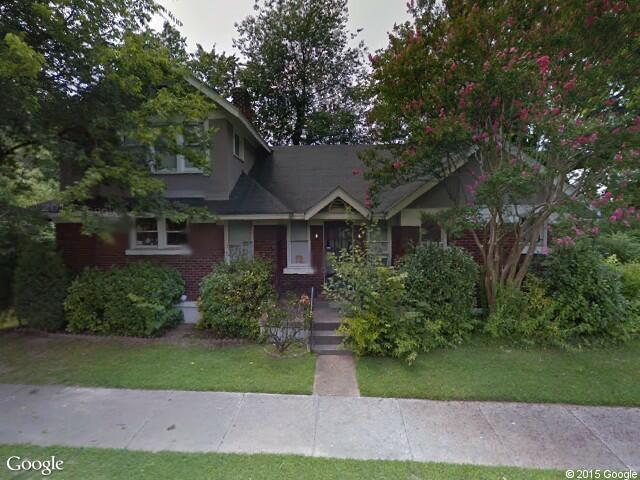
Young Tom Williams lived in St. Louis. He was a quiet well mannered lad in his early twenties who liked to read and enjoyed spending the summers in Memphis with his mother’s parents, the Dakins. Tom had recently dropped out of the University of Missouri, lost his job in the warehouse of Continental Shoes, where his father was an executive, and, except for a keen abiding interest in literature, looked to be at loose ends. Walter Dakin, his grandfather, served as a member of the clergy at Calvary Episcopal Church, which was downtown on 2nd and Adams. (Granny, a faithful communicant of Calvary, may have known Reverend Dakin or, more certainly, known of him.) Their house on Snowden was only a block from Southwestern College where Reverend Dakin was a friend of the head of the English Department, Professor Knolle Rhodes, who allowed Tom access to the library where he spent many afternoons reading the plays of Anton Chekhov. “I fell in love with the writing of Anton Chekhov,” Tom remembered. “They introduced me to a sensibility to which I felt a close affinity . . . I still am in love with the delicate poetry of his writing and THE SEA GULL is still, I think, the greatest of modern plays.”
Next door to the Dakins lived a Jewish family named Shapiro and Tom became friends with the children, a brother and sister, often talking with them on their front porch in the mornings. The brother liked Tom, but did not think there was anything extraordinary about him. The sister, Dorothy, was a member of a local dramatic club called The Rose Arbor Players and asked Tom to collaborate with her on a play. So he wrote a short drama called Cairo, Shanghai, Bombay!, that was produced “on the great back sloping lawn” of a lady patron named Mrs. Roseborough who lived in a larger house a couple of miles away on the southern edge of midtown.
It was a farcical play about two sailors in port and out on the town who make propositions to a couple of “light ladies,” and was pleasing and amusing to the audience. On the program Tom was identified as a collaborator and given second billing to Dorothy, who wrote “a quite unnecessary and . . . undistinguished prologue to the play. Thank God, the prologue was short: that’s all I can remember in its favor. . . Still, the laughter, genuine and loud, at the comedy I had written enchanted me,” remembered Tom.
Years later and years ago, I encountered the brother, Dr. Shapiro, a physician in Memphis, who had lived next door to Tom in the summer of ’34. I am not a theatre person, but I enjoy reading plays and nothing has ever moved me more than The Glass Menagerie, which I first read as freshman at the University of Tennessee and have had a fascination for the author and his work ever since. Dr. Shapiro told me about Tom, “a chunky fellow, kinda quiet and nice. Our conversations were typical of the time and our age and I had no idea and was surprised when he became so famous,” and the night of his first play, “I don’t really remember how the people reacted, if they laughed or what, but it was a one-act play so everyone stayed to the end.”
Determined to find this place and see the lawn, I set out from Snowden Avenue one summer evening and drove south down McLean about a mile to Glenview Park at Southern Avenue. The home is just a few blocks away at 1780 Glenview Drive in what had become a colored neighborhood full of middle class working Negroes.
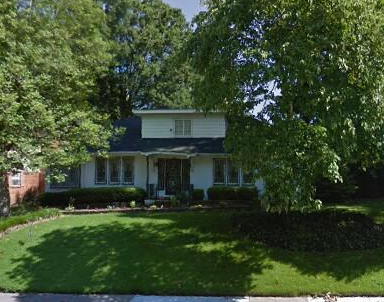
The house is white with a slanting gray roof, the eves of an attic window jut out from the center of the roof and there is no front porch. The lady who lived there came out and we talked. She was colored and about sixty years old and was gracious and friendly. “When the Lawd give ya something good, you must take care of it,” she said about the house. She knew about the play too, and was understanding, “people come here all the time,” she said rather mournfully, and let me take a look at the back yard, which is fenced and shaded by large oak trees. The lawn did not slope, but I did notice a flat mound raised in the rear which was probably where the plays were presented. It was a hot evening and I thanked the lady and, getting back into my car, thought about that hot summer night in 1934 when people gathered in the backyard of a small house in Memphis to watch a play by an unknown author. “Then and there,” wrote Tennessee Williams in MEMOIRS, ”the theatre and I found each other for better and for worse. I know it’s the only thing that saved my life.” And I thought about all the great plays that came after it.
 Wylie Graham Mclallen