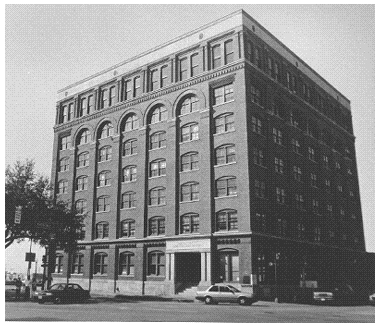
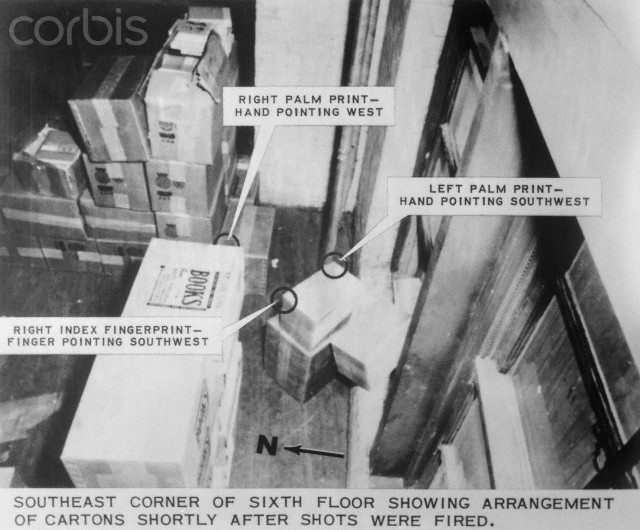
Minutes before the Presidential Motorcade came through downtown Dallas in the early afternoon, he was seen in the sixth floor window of the Texas School Book Depository; the description given to the police was accurate enough for a police officer to stop him on the streets within the hour. It was a mild sunny day late in November. He shot the President at 12:30 pm, left the rifle and the paper bag he used to bring it to work on the sixth floor (the bag by the window, the rifle between boxes across the room near the stairs), took the stairwell to the lunch room on the second floor where he was stopped at gunpoint by Patrolman M. L. Baker, who had just entered the building. Oswald was calm; he was wearing pants and a T-shirt. The accompanying supervisor, Roy Truly, recognized him as one of the workers. They let him go. He bought a bottle of Coca-Cola at the coke machine, and then walked through the clerical office toward the door leading to stairs at the front of the building. Mrs. R. A. Reid, the office supervisor, had been watching the parade on the sidewalk; she rushed back inside after hearing three shots and saw him as he headed to the door. “The President has been shot,” she said. Oswald mumbled something and kept on walking. About three minutes had passed since he shot the President and the building was not yet sealed.
Outside on the streets, he walked seven blocks east on Elm Street, boarded a bus heading back toward the School Book Depository to the Oak Cliff area of Dallas (a former landlady, who disliked him so much she had refused to continue to let him rent, happened to be on the bus and recognized him), but traffic was heavy and the bus moved too slow, so after two blocks Oswald got off and probably walked south along Lamar to the Greyhound Bus Station where he hired a taxi (first offering it to an older woman who declined). Sirens were wailing and police cars were crisscrossing the streets. The driver, William Whaley, remarked, “What the hell is the uproar,” but Oswald did not speak. The taxi went southwest to the 700 block of Beckley Street (about a six minute drive), a few blocks past the house where Oswald rented a room. He paid the cabbie a dollar, leaving a nickel tip, and walked back to his rooming house.
It was approximately one o’clock when he entered the house at 1026 North Beckley: half an hour since shooting the President. The housekeeper, Earlene Johnson, was watching TV when he entered. “You’re in a hurry,” she said. He made no reply, but rushed to his room where he grabbed a jacket and revolver. Zipping up the jacket, he left the house and stood near the bus stop in front of the house on the east side of the street. He was next noticed about a mile away, walking east at a very brisk pace along the south side of 10th Street, when confronted by Officer Tippit, who pulled alongside and called him to his car. It was 1:15. Oswald approached and exchanged words with Tippit through the right front window. There was something about him. Officer Tippit stepped out of the car and moved to the front of the vehicle. Oswald shot him three times in the chest and once in the head and started running. He cut across a yard through some bushes, ejected the empty shells, and ran down Patton Avenue toward Jefferson Boulevard. One of the witnesses, a woman, screamed and ran to the body now lying in a pool of blood. Domingo Benavides, driving a pickup truck, stopped, waited until the gunman had fled, then called in the murder on Tippit’s car radio. There were several other eyewitnesses. Two men tried to chase him down in a taxicab, but he disappeared. Four men at used-car lot on the southeast corner of Patton and Jefferson watched him run south and turn west; two decided to follow, but he disappeared again, this time behind a gas station where he discarded his jacket under a car in a parking lot behind the station.
As police sirens sounded along Jefferson Boulevard, Oswald reappeared in the recessed arcade of Hardy’s Shoe Store, his back to the street, where he caught the attention of the manager Johnny Brewer, who later said, “his hair ….was messed up …..he had been running ….he looked scared and he looked funny.” When the sirens grew fainter, the man looked over his shoulder and walked on. Brewer followed and, a few stores down, watched him duck into the Texas Theatre without buying a ticket. Julia Postal, who had stepped away from the ticket booth to see what was going on along the street, saw him also. “I don’t know if this is the man they want ….but he’s running from them for some reason,” she told Brewer, sending him into the theatre to find him while she called the police.
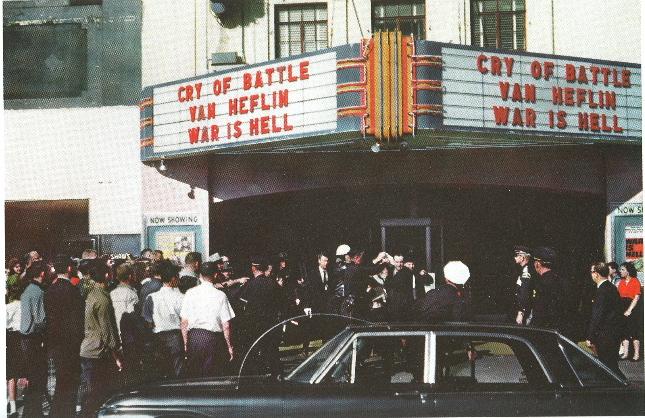
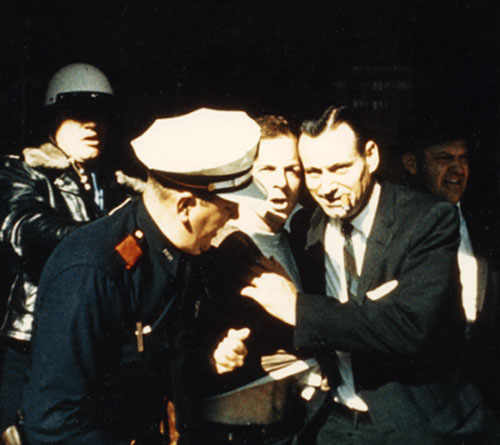
Patrol cars bearing at least 15 officers converged on the theatre. They entered the darkened theatre from the front and rear and searched the balcony. The lights went on. Brewer stepped on to the stage and pointed out Oswald, who sat alone in the rear of the main floor near the right center aisle. Officer McDonald ordered him to his feet; “Well, it’s all over now,” he heard Oswald say, and then the assault and fight. Oswald struck him between the eyes and pulled his gun; McDonald struck back and grabbed the gun. Three more officers moved in and grabbed Oswald from the front, rear, and side. Oswald tried to shoot his weapon but it misfired (the webbing of McDonald’s hand might have come between the hammer and the cartridge). After a struggle, the suspect was subdued and handcuffed and lead out of the theatre: he muttered curses and hollered about police brutality. At 1:51 the police reported by radio they were on their way to headquarters with the suspected killer of Officer Tippit. By the time they got to the station Oswald, the only employee missing at the School Book Depository, was identified as a prime suspect in the assassination of President Kennedy.
Two days later while being transferred from the basement of the Dallas Police Department to the county jail, in full view of the national media, Oswald was shot by Jack Ruby. Jack Ruby was convicted and sentenced to death and died of cancer while incarcerated. Because of the easy access with which Ruby stalked and killed Oswald, the Warren Commission raised important issues concerning the conduct of law enforcement officials, the responsibilities of the press, the rights of the accused, and the administration of criminal justice in the United States. Also, Presidents no longer ride in open limousines.
 Wylie Graham Mclallen
I don’t know why people keep repeating this nonsense as if they were facts? Nobody even bothers to think about anything. They just repeat.
How do you think it happened?
This is a very accurate description of what happened that day.
Oswald was the lone assassin.
George Vreeland Hill
Most of the research came from the Warren Report. Whatever else might be said about the Warren Report, they did exhaustive interviews on anyone even slightly involved with what happened that day and the people interviewed had memories still fresh in mind.